

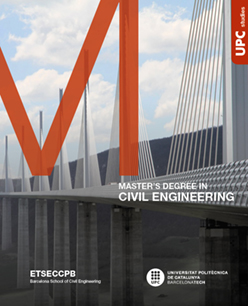
Master's degree in Civil Engineering
Barcelona School of Civil Engineering (ETSECCPB)
Master's degree in Civil Engineering (master's degree website) provides advanced multidisciplinary and technological training that will enable you to work in research, design and analysis of infrastructure and civil engineering projects and will qualify you to practise as a civil engineer.
The curriculum reinforces prior learning in mathematics, physics, science and technology on the bachelor's degree course by teaching students the most advanced and experimental techniques for modelling in engineering. The master's degree includes study abroad at some of the most prestigious engineering schools in the world in the framework of mobility programmes and agreements.
It provides future professionals with a solid technical grounding in designing infrastructure and supervising its development, and in planning and managing environmental services and resources for spatial planning.
Specialisations
- Computational Engineering
- Environmental Engineering and Sustainability
- Geotechnical Engineering
- Structural Engineering and Construction
- Transport Engineering and Urbanism
- Water Engineering
- Duration and start date
- 2 academic years, 120 ECTS credits. Starting February and September
- Timetable and delivery
- Mornings. Face-to-face
- Fees and grants
- Approximate fees for the master’s degree, excluding other costs (does not include non-teaching academic fees and issuing of the degree certificate):
€2,122 (€5,400 for non-EU residents).
More information about fees and payment options
More information about grants and loans - Language of instruction
Check the language of instruction for each subject in the course guide.
Information on language use in the classroom and students’ language rights.
- Location
- Official degree
- Recorded in the Ministry of Science, Innovation and Universities
- General requirements
- Academic requirements for admission to master's degrees
- Specific requirements
The following candidates may apply for enrolment:
- Holders of an official bachelor's degree that qualifies them to practise the regulated profession of technical public works engineer or
- Holders of an official bachelor's degree that provides the competencies outlined in Ministerial Order CIN/307/2009, of 9 February, in accordance with the provisions of Section 4.2.2 of Order CIN/309/2009, of 9 February or
- Students on double-degree programmes that include the professional-track master's degree in Civil Engineering under the continuity system.
- Holders of other qualifications, in accordance with the provisions of Section 4.2.3 of Order CIN/309/2009, of 9 February.
Admission criteria and application periods can be consulted on the website of the Barcelona School of Civil Engineering: https://camins.upc.edu/en/Studies/master?set_language=en
- New intake places
- 60 in September; 60 in February
- Pre-enrolment
- Pre-enrolment period open.
Expected deadline: 11/11/2026.
How to pre-enrol - Enrolment
- How to enrol
- Legalisation of foreign documents
- All documents issued in non-EU countries must be legalised and bear the corresponding apostille.
- Complete list of subjects by speciality + course guide
-
- Specialisation in (Eng) Especialitat en Enginyeria Ambiental i Sostenibilitat
- Specialisation in (Eng) Especialitat en Enginyeria Computacional
- Specialisation in (Eng) Especialitat en Enginyeria d'Estructures i Construcció
- Specialisation in (Eng) Especialitat en Enginyeria de l'Aigua
- Specialisation in (Eng) Especialitat en Enginyeria del Terreny
- Specialisation in (Eng) Especialitat en Enginyeria del Transport i Urbanisme
First course
- Computational Engineering 6
- Continuum Mechanics 9
- Geomechanical and Geotechnical Engineering 6
- Hydraulic Infrastructure 4.5
- Numerical Modelling 9
- Planning and Management of Transport 6
- Structural Analysis 7.5
- Structural Engineering 6
- Water Engineering 6
- Computational Engineering 6
- Continuum Mechanics 9
- Geomechanical and Geotechnical Engineering 6
- Hydraulic Infrastructure 4.5
- Numerical Modelling 9
- Planning and Management of Transport 6
- Structural Analysis 7.5
- Structural Engineering 6
- Water Engineering 6
- Computational Engineering 6
- Continuum Mechanics 9
- Geomechanical and Geotechnical Engineering 6
- Hydraulic Infrastructure 4.5
- Numerical Modelling 9
- Planning and Management of Transport 6
- Structural Analysis 7.5
- Structural Engineering 6
- Water Engineering 6
- Computational Engineering 6
- Continuum Mechanics 9
- Geomechanical and Geotechnical Engineering 6
- Hydraulic Infrastructure 4.5
- Numerical Modelling 9
- Planning and Management of Transport 6
- Structural Analysis 7.5
- Structural Engineering 6
- Water Engineering 6
- Computational Engineering 6
- Continuum Mechanics 9
- Geomechanical and Geotechnical Engineering 6
- Hydraulic Infrastructure 4.5
- Numerical Modelling 9
- Planning and Management of Transport 6
- Structural Analysis 7.5
- Structural Engineering 6
- Water Engineering 6
- Computational Engineering 6
- Continuum Mechanics 9
- Geomechanical and Geotechnical Engineering 6
- Hydraulic Infrastructure 4.5
- Numerical Modelling 9
- Planning and Management of Transport 6
- Structural Analysis 7.5
- Structural Engineering 6
- Water Engineering 6
Second course
- Environmental Modelling 5
- Life Cycle Analysis and Sustainability Assessment 5
- Sustainability and Development Engineering 5
- Water Treatment 5
- Earthquake Risk Assessment and Reduction 5
- Mixed and Composite Structures 5
- Structural Management 5
- Master's Thesis 25
- Computational Engineering for Design and Operation 5
- Machine Learning and Models for Decision Making 5
- Models and Tools for Project and Financial Management 5
- Numerical Models in Civil and Structural Engineering 5
- Earthquake Risk Assessment and Reduction 5
- Mixed and Composite Structures 5
- Structural Management 5
- Master's Thesis 25
- Advanced Design of Concrete Structures 5
- Analysis and Design of Steel Structures 5
- Bridges 5
- Building Structures 5
- Earthquake Risk Assessment and Reduction 5
- Mixed and Composite Structures 5
- Structural Management 5
- Master's Thesis 25
- Coastal Engineering and Management 5
- Port and Offshore Engineering 5
- River Dynamics 5
- Urban Hydrology 5
- Earthquake Risk Assessment and Reduction 5
- Mixed and Composite Structures 5
- Structural Management 5
- Master's Thesis 25
- Geomechanics of Failures 5
- Geotechnical Design and Construction 5
- Interaction Between Groundwater and Civil Works 5
- Tunnels and Rock Mechanics 5
- Earthquake Risk Assessment and Reduction 5
- Mixed and Composite Structures 5
- Structural Management 5
- Master's Thesis 25
- High Speed Railway Line Management 5
- Planning and Operation of Road Networks 5
- Urban Mobility 5
- Urban Planning and Urban Service Infrastructure 5
- Earthquake Risk Assessment and Reduction 5
- Mixed and Composite Structures 5
- Structural Management 5
- Master's Thesis 25
- CompulsoryECTS
- OptionalECTS
- ProjectECTS
Professional opportunities
- Professional opportunities
Professionally, civil engineers tend to be involved in activities related to the supervision, execution, maintenance and management of large-scale infrastructure works in the field of civil engineering. Their responsibilities generally lie in communication and transport channels, building construction and structures, studies of soil and rock mechanics, ports and coastal management, hydraulics and energy, and urbanism and spatial planning—all of which must be informed by the strictest environmental concerns.
They may be employed in the private sector and in public administration, and may work as freelance advisors and consultants. They can also be involved in research, development and innovation at public and private research centres, in the R&D departments of large companies, and in teaching.
- Competencies
-
Generic competencies
Generic competencies are the skills that graduates acquire regardless of the degree or field of study. The generic competencies established by the UPC are capacity for innovation and entrepreneurship, sustainability and social commitment, teamwork, proper use of information resources, knowledge of a foreign language (preferably English) and gender perspective.
Graduates of the master's degree in Civil Engineering are highly qualified in the following areas:
- Design, which includes social, economic, technical, environmental and management dimensions.
- Planning, as a stage prior to development, design and construction.
- The sustainable management of large-scale infrastructure, urban and interurban areas and communication and service systems.
- Management and coordination of human teams, including large multidisciplinary teams.
Specific competencies
- The ability to address and solve advanced mathematical problems in engineering, from the scope and context of the problem to its statement and implementation in a computer program. In particular, the ability to formulate, program and apply advanced analytical and numerical calculation models to design, planning and management, as well as the ability to interpret the results obtained in a civil engineering context.
- Comprehension and mastery of the laws governing the thermomechanics of continuous media for their application in fields of engineering such as fluid mechanics, the mechanics of materials and structural theory.
- The ability to apply knowledge of soil and rock mechanics to the study, design, construction and operation of foundations, cuts, fills, tunnels and other constructions over or through land, whatever its nature and state, and whatever the purpose of the work.
- Knowledge of and competence in the application of advanced structural design and calculations for structural analysis, based on knowledge and understanding of forces and their application to civil engineering structures, and the ability to assess structural integrity.
- Knowledge of all kinds of structures and materials and the ability to design, execute and maintain civil engineering structures and buildings.
- The ability to plan, dimension, construct and maintain hydraulic works.
- The ability to plan, evaluate and regulate the use of surface water and groundwater resources.
- The ability to plan and dimension water and wastewater processing and treatment systems.
- Knowledge of and the ability to understand dynamic phenomena of the coastal ocean and atmosphere and respond to problems encountered in port and coastal areas, including the environmental impact of coastal interventions, and the ability to carry out maritime works studies and projects.
- Knowledge of transport engineering and planning, transport types and functions, urban transport, management of public transport services, demand, costs, logistics and financing of transport infrastructure and services.
- The ability to analyse and interpret the social, cultural, environmental and economic factors affecting a territory and to carry out spatial and urban planning from the perspective of sustainable development.
- A capacity for the planning, management and operation of civil engineering infrastructure.
- Master's degree in Civil Engineering + Master's degree in Urban Mobility
- Master's degree in Civil Engineering + Master's degree in Structural and Construction Engineering
Further information
- UPC school
- Barcelona School of Civil Engineering (ETSECCPB)
- Academic coordinator
- Miquel Estrada Romeu
- Academic calendar
- General academic calendar for bachelor’s, master’s and doctoral degrees
- Academic regulations
- Academic regulations for master's degrees at the UPC
Pre-enrolment
Pre-enrolment for this master’s degree is currently closed.
Use the “Request information” form to ask for information on upcoming pre-enrolment periods.