


13 UPC researchers distinguished in the 2025 Academia Excellence programme
Researcher Claudio Cazorla named new ICREA Professor
Claudio Cazorla Silva, a researcher at the Barcelona Research Center in Multiscale Science and Engineering (CCEM), has been selected to become part of the community of ICREA Research Professors.
Cazorla joined the UPC in 2019 as a Ramón y Cajal researcher, following several teaching and research visits in Spain, the United Kingdom and Australia. His research lies at the intersection of materials physics, advanced simulations and machine learning, leveraging the growing capabilities of computational methods and artificial intelligence to accelerate the discovery, design and understanding of next-generation materials for energy storage and conversion. These materials include solid-state electrolytes for electrochemical energy storage, caloric materials for environmentally friendly heating and cooling, photovoltaic compounds for sustainable energy generation and catalytic nanostructures for the production of green fuels and chemicals.
With Claudio Cazorla, there are now 9 UPC researchers recognised as ICREA Research Professors. The other professors in this group are Conrado Aparicio Badenas, Xavier Cabré Vilagut, Cigdem Eskicioglu, Marco Gualtieri, Marta Mazzocco, Kasper Moth-Poulsen, Kestutis Staliunas i Andriy Yaroshchuk Novikov.
UPC research took centre stage in the latest call for the Government of Catalonia’s Academia Excellence programme (formerly ICREA Academia), securing 13 of the 50 grants awarded. The UPC thus becomes the institution with the most selected faculty members, who will be able to intensify their research for five years. Also, Claudio Cazorla Silva, a researcher at the Barcelona Research Center in Multiscale Science and Engineering (CCEM), has been named a new ICREA Research Professor.
Dec 18, 2025
A total of 50 faculty members from the Catalan university system have been selected in the new call for Academia Excellence grants (formerly ICREA Academia), 13 of whom are researchers from the Universitat Politècnica de Catalunya - BarcelonaTech (UPC). With funding of €200,000 for each project, the programme will allow them to intensify their research for five years.
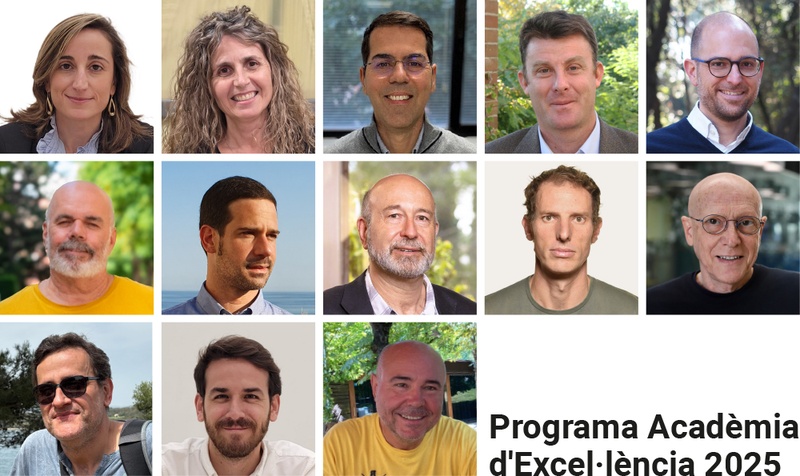
The researchers selected for the 2025 Academia Excellence programme are as follows:
- Mònica Aragüés Peñalba, a researcher at the Centre for Technological Innovation in Static Converters and Drives (CITCEA-UPC) and a professor at the Barcelona School of Industrial Engineering (ETSEIB). Her research focuses on the operation and planning of power grids with high penetration of renewable energy. In the coming years, she will continue to explore how the application of machine learning techniques can extract value from data from smart meters and sensors. Aragüés will also develop tools based on optimisation and machine learning to facilitate the efficient operation and optimal integration of large data centres into the electricity system. Finally, she will investigate how quantum computing can provide solutions to electricity system problems that cannot be addressed through classical computing.
- Mònica Ardanuy Raso, a researcher at the Textile Technology Research Group (TECTEX) and a professor at the Terrassa School of Industrial, Aerospace and Audiovisual Engineering (ESEIAAT). The Academia Excellence distinction will allow Ardanuy to intensify her research into solving challenges associated with the recycling of textile materials and the development of advanced textiles. In the field of recycling, she will focus on optimising the recovery of high-quality fibres from textile waste using sustainable processes. Regarding the development of advanced materials, the research will focus on solutions that provide functionality while maintaining textile properties.
- Marino Arroyo Balaguer, a researcher at the Numerical Methods for Applied Sciences and Engineering research group (LACÀN) and the Institute of Mathematics of the UPC, who is affiliated with the Barcelona School of Civil Engineering (ETSECCPB). Using theoretical and computational models, Arroyo plans to address challenges in the mechanobiology of living tissues, for example, how homeostasis in rapidly renewing tissues like the intestinal epithelium is regulated, what mechanical processes explain tumour invasion or how 3D cell sheets change shape. He will also investigate what can be learned from nature to create new engineering materials, biohybrid or inert, with shape-changing capabilities.
- Michele Chiumenti, a researcher at the International Centre for Numerical Methods in Engineering (CIMNE) and a professor at the Barcelona School of Civil Engineering (ETSECCPB). His research focuses on a machine learning-assisted computational mechanics framework for real-time monitoring with adaptive control for defect prediction in closed-loop manufacturing.
- Josep Maria Font Llagunes, a researcher in the Health Technologies research group (TecSalut) and the Health Research and Innovation Institute (IRIS), and a professor at the Barcelona School of Industrial Engineering (ETSEIB). His project aims to obtain a new generation of personalised motor rehabilitation therapies for neurological patients by integrating real-time biomechanical simulation with wearable technologies—smart sensors and robotic exoskeletons. Font will investigate adaptive control algorithms for exoskeletons that assist gait according to the patient’s needs at any given time, as well as wearable sensors for motor assessment during daily life. The project also includes a strategy for comprehensive doctoral training and international collaboration through alliances with clinical and research centres worldwide.
- José Antonio Jiménez Quintana, a researcher at the Maritime Engineering Laboratory (LIM) and a professor at the Barcelona School of Civil Engineering (ETSECCPB). Jiménez’s research plan for the next five years will address threats arising from sea level rise, altered storm patterns and compound flooding, using the Catalan coast as a key testbed. The project will develop cross-disciplinary multi-hazard risk assessment frameworks by integrating dynamic physical processes with socioeconomic factors to reduce persistent gaps between complex climate projections and territory-specific adaptation strategies.
- Lluís Jofre Cruanyes, a researcher at the Fluid Science and Engineering Research Group (GReCEF) and the Specific Centre for Hydrogen Research (CER-H2), who is affiliated with the Barcelona East School of Engineering (EEBE). The Multiscale Fluid Mechanics Lab, led by Jofre, will deploy a research strategy based on deciphering the physics of complex turbulent flows and developing digital twins for real-time prediction. The programme’s execution will combine high-fidelity simulation and experimentation to tackle three key technological challenges: the design of space micropropulsion with supercritical fluids, the aerodynamic diagnosis of vehicles using dispersed sensors and the remote detection of oceanic microplastics using AI.
- Jordi Llorca Piqué, a researcher at the Barcelona Research Center in Multiscale Science and Engineering (CCEM) and the Specific Centre for Hydrogen Research (CER-H2), who is affiliated with the Barcelona East School of Engineering (EEBE). The research project led by Llorca promotes a new generation of catalysts developed using mechanochemical techniques, an innovative approach that allows for the creation of completely new active sites with extraordinary reactivity, opening the door to more efficient and sustainable chemical processes. These new catalysts will be tested in three major scientific and technological challenges: hydrogen production, carbon dioxide reduction and the removal of atmospheric pollutants. The project has the potential to contribute decisively to a cleaner and more sustainable energy future.
- Pol Marcel Lloveras Muntané, a researcher at the Barcelona Research Center in Multiscale Science and Engineering (CCEM) and the Materials Characterisation Group (GCM), who is affiliated with the Barcelona East School of Engineering (EEBE). Lloveras aims to develop and optimise hybrid organic-inorganic solid materials with highly energetic phase transitions to store waste heat from industrial sources or renewable generation, with the goal of improving process efficiency and energy management. The solid nature of the materials minimises leaks and allows for optimised morphologies for heat exchange.
- Jordi Martorell Pena, a researcher at the Department of Physics and a professor at the Castelldefels School of Telecommunications and Aerospace Engineering (EETAC). At a time when different types of photovoltaic technologies are close to their theoretical efficiency limit, Martorell’s project proposes a new way to overcome these limitations. The idea is to reduce Boltzmann losses in solar cells by effectively limiting photon emission. To achieve this, disordered three-dimensional nanophotonic structures, designed using neural networks, will be employed.
- Romualdo Pastor Satorras, a researcher at the Condensed, Complex and Quantum Matter Group (CCQM) and a professor at the Barcelona School of Informatics (FIB). In his project, Pastor investigates how groups, ranging from animal collectives to human societies, reach shared decisions through local interactions and network communication. To do this, he combines theoretical modelling, data analysis and controlled experiments to understand the principles driving coordination, leadership, polarisation and the diffusion of opinions or behaviours. By linking collective movement, social decision-making, contagion models and complex network structures, Pastor will build an integrated framework for understanding decentralised collective intelligence.
- Eduardo Prieto Araujo, a researcher at the Centre for Technological Innovation in Static Converters and Drives (CITCEA-UPC) and a professor at the Barcelona School of Industrial Engineering (ETSEIB). The project he is developing focuses on creating tools to analyse, design, operate and control modern power grids, dominated by power electronics, with the aim of decarbonising them quickly, efficiently and safely. These tools will respond to the challenges arising from the transformation that the traditional electricity system is undergoing at all levels, driven by the massive deployment of renewable energies, storage systems, electric vehicles, hydrogen applications and HVDC/FACTS infrastructures, together with the progressive abandonment of conventional, fossil-fuel generation.
- Luis Domingo Velasco Esteban, a researcher at the Optical Communications Group (GCO) and the Advanced Broadband Communications Centre (CCABA), who is affiliated with the Barcelona School of Informatics (FIB). Velasco will work on cloud architectures for telecommunications capable of providing services with hundreds of gigabits per second performance, such as federated learning and generative artificial intelligence. He will also study other services that require end-to-end delays of hundreds of microseconds and 7.9 seconds of availability, as in industrial applications and robotics